

Is Knowledge Retention a Massive Project? Not This Way

Many organizations know they need to address knowledge retention. The expert who has been on the line for thirty years is retiring soon. Yet, the project keeps being postponed because where do you actually begin? And who has time for such a massive project? What they don’t know is that it can actually be very easy. With a small step and a predictable end result. We explain how.
The Mindset Holding You Back
There is a persistent thought in decision-making regarding knowledge management: you can only start once you have the full picture. Which experts do you need? Which departments? Which workstations actually need to be documented? How do you integrate this with your MES? These are good questions, but far too complicated in the initial phase.
Doing it right is not the same as doing it big. In fact, large-scale approaches often end in failure. It becomes too much, too time-consuming, and too complex.
The good news is that it can be much simpler, with one small, focused step: a pilot project. With a pilot, you can focus on capturing the knowledge of one expert regarding one critical process. In a few weeks, you will discover what works and what it delivers for your organization.
A Pilot at ELICIT: How It Works
Most ELICIT projects begin with a pilot project. It works like this: a knowledge analyst conducts an average of five structured interviews with your expert. In an average of 110 questions, the analyst maps out the expert’s experiential knowledge. The decision logic, the exceptions, the subtle signals—in short: the methods an experienced operator developed over years but never wrote down.
That knowledge is converted into a digital knowledge system. A clear, searchable, and accessible model on a screen on the shop floor. Operators find what they need within two clicks, even in the middle of the night, even when that one expert is on vacation. The time it takes? About twelve weeks. And then you can immediately start measuring the effect.
What Van Merksteijn Learned from One Workstation
Van Merksteijn International, a manufacturer of reinforcement products and fencing panels in Almelo, started with one knowledge system for the Schlatter welding line. After the launch, operators were able to independently check what was wrong in case of deviations, without calling their most experienced colleague.
And that had an immediate effect. Project Manager Bulent Simsek: “We notice in everything that things are improving. There is much less downtime.” Van Merksteijn now has knowledge files for almost all production processes. More than 150 employees work with them. It all started with one workstation.
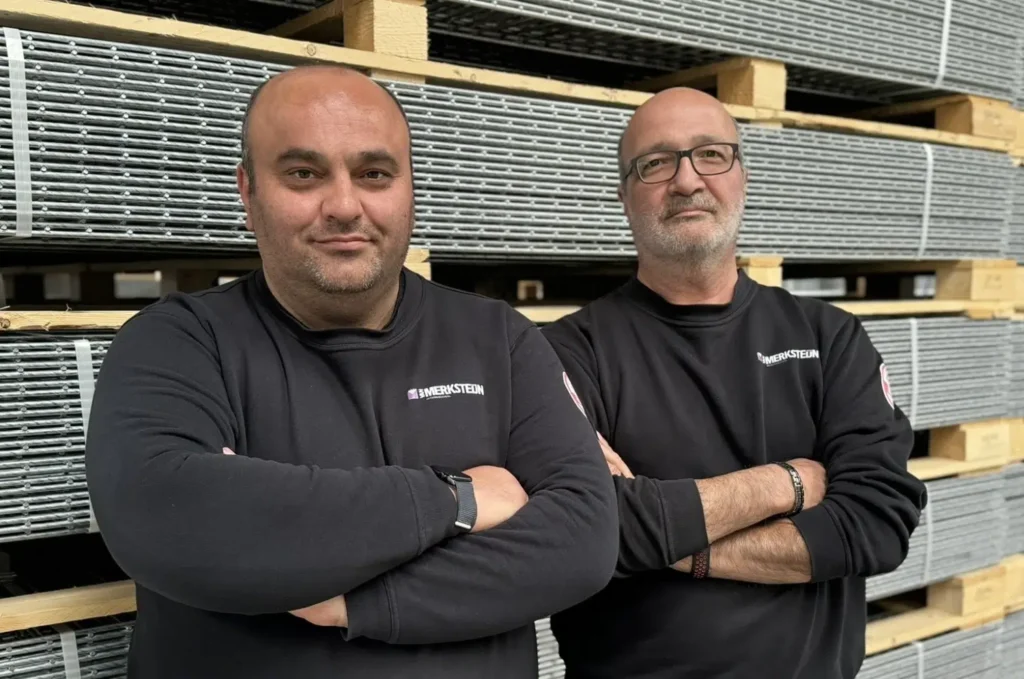
“No one has to wait for another when there is a malfunction. We notice in everything that production is improving. There is much less downtime. Ultimately, that is what it is all about.”
Bülent Şimşek, Project Manager at Van Merksteijn International
What It Delivers for Your Organization
Organizations that start with a pilot almost always expand. The results speak for themselves. Naturally, the most important result is a knowledge system that helps operators make decisions like an experienced expert every day. Additionally, organizations gain important insights in a short period of time:
- You build internal experience with an approach that you can then repeat on other machines, other departments, and other locations.
- You discover which knowledge in your organization is most vulnerable.
- You see how operators actually use the information and what they are still missing.
- You get a concrete picture of the time investment required from experts.
Launching a Pilot? Use These Three Criteria
If you are unsure which workstation or process to document first, use these three questions:
- Where is the dependency on one or two people the greatest?
That is where the risk is highest and the benefit is most immediately felt. - Where is the onboarding time for new operators the longest?
If someone needs twelve to eighteen months to operate independently, there is enormous potential for gain there. - Where do you see the most variation between shifts?
Inconsistency is a symptom of knowledge that is not shared. That is the place where a knowledge system is needed most.
There Is Only One Real Requirement
You don’t need to set aside a large budget, start an IT project, or go through a months-long selection procedure. The only real requirement is that you have an expert in-house, someone who possesses the knowledge you want to retain. The rest is: conversations, a structured approach, and the willingness to start.
Do You Want to Know Which Process or Expert Is Best Suited as a Starting Point?
Please contact us for an introductory meeting. Together, we will look at the risks that are currently greatest and how a pilot can solve them immediately.