
The silver tsunami is hitting your factory too: what now?
You have known it for a while. In eight months, he will be retired. ‘Henk’, who has worked on line 3 for 38 years. Henk, who knows with a single glance at the dashboard whether the mixer is set correctly. Who can tell you within five minutes why you had quality deviations last week and what you need to do to prevent them. That Henk will soon be gone, and he is taking all his knowledge with him.
Have you really taken care of it?
And of course, you have “taken care of it.” Dennis is now shadowing Henk. Dennis is motivated, eager to learn, and intelligent. After six months of shadowing, Dennis knows where the buttons are. He can operate the machine according to the standard procedure. But in practice, this happens:
Months 1-2: Dennis watches Henk work. He learns where the buttons are, how to start the machine, and what the standard procedure is. He asks questions. Henk explains patiently.
Months 3-4: Dennis can operate the machine independently if everything proceeds normally. He feels competent. Henk is satisfied: “He’s doing well.”
Months 5-6: Dennis takes over more and more tasks. Henk gets more time for improvement projects. The handover seems successful.
Month 8: Henk has retired. Dennis is now running the operation independently.
Month 9: Something goes wrong. A deviation that Henk would have solved within five minutes occurs, but Dennis does not see the signal. Or he does see it, but does not know what it means. Or he thinks he knows what to do, but misses the nuance that makes the difference between “problem solved” and “root cause addressed.”
Dennis lacks the 38 years of experience that Henk has in his head. The result? Downtime. Quality deviations. Costs. And in the worst case: Dennis becoming frustrated because he feels he is failing.
Did you know that the silver tsunami is only just beginning?
In five years, 30% of current experts will be retired. In ten years, it will be 50%.
The real problem: decision-making knowledge vs. procedural knowledge
This situation is currently unfolding in hundreds of Dutch factories. The silver tsunami—the large-scale outflow of experienced employees—poses a real risk to the continuity of your production.
Why? Because essential experiential knowledge is leaving. Knowledge that is not captured in procedures and work instructions. Knowledge that tells you not only what to do, but also why and when to do something. We call that knowledge decision-making knowledge.
Example:
The procedure says: “In case of temperature deviation >2°C, press the reset button.”
Henk’s decision-making knowledge says: “If the temperature deviates >2°C and you see that the humidity sensor is also above 65% and it is a hot day, then it is caused by the climate control. Resetting solves nothing. You must first check the cooling. But if the humidity sensor is normal, then the problem lies in the mixer itself and you must reset, but also immediately check if the heating element seal is still intact.”
This is documented nowhere. This has been built up through 38 years of experience, thousands of situations, and hundreds of times trying something that didn’t work and thereby learning what does work. And this is exactly what disappears when Henk leaves.
Why documentation does not help
“But we document everything!” I hear you think. And that is correct. You probably have:
- Standard Operating Procedures (SOPs)
- Fault charts
- Settings lists
- Flowcharts
- Perhaps even videos
Yet this does not work.
Why? Because experts cannot describe their work. They operate at a level of intuition that they do not consciously experience themselves.
If you ask Henk: “How do you know if the mixer is set correctly?”, he says: “You just hear it.” But what he doesn’t realize is that he is simultaneously looking at three displays, monitoring the consistency of the product, checking if the dosing speeds match what he expects based on the outside temperature that morning, and deciding based on a pattern he has seen a thousand times before.
Ask him to document that and you get: “Listen for strange noise at mixer.” That is not enough to get Dennis to the same level.
The real solution: systematic knowledge management
The only way to truly solve this problem is by systematically capturing the decision-making knowledge of experts. Not by asking “what do you do?”, but by uncovering “how do you decide?”.
This requires a different approach than the instructions you are familiar with:
- Not: “Explain how the machine works”
- But: “Tell me about the last time line 3 came to an unexpected standstill. What did you see? What did you do first? Why not something else? What told you that this was the right approach?”
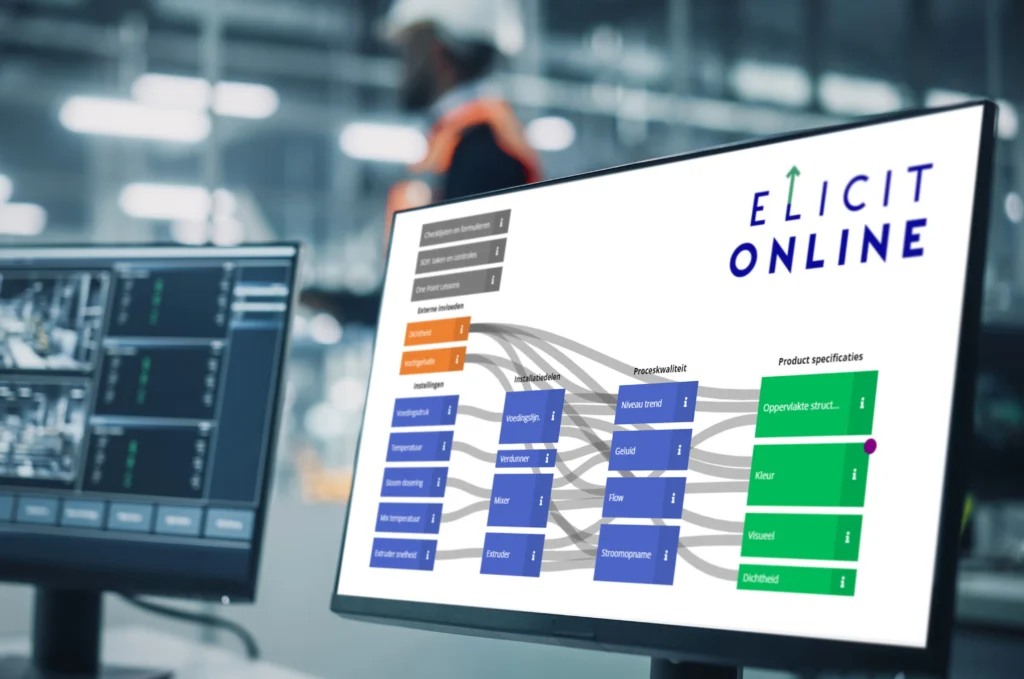
By extracting this knowledge from the minds of your experienced experts and making it accessible to others 24/7, you give all the Dennises of this world the chance to reach Henk’s level rapidly.
How do you extract knowledge from minds?
Results at other organizations
FrieslandCampina
At FrieslandCampina Beilen, they uncovered decision-making knowledge for their production process. The results were clearly visible:
“We see a clear decrease in the number of support requests coming into our support services,” says the process operator. “Because we know how to recover from deviations faster, the error margin decreases and the average quality improves.”
Operators can now understand cause-and-effect relationships themselves. In the event of foaming in the process, they now know which steps to follow. The result: faster recovery from deviations and better average quality.
JDE Joure (Douwe Egberts, L’Or, Pickwick)
At JDE Joure, new operators can easily diagnose problems themselves and see how to resolve them. As a result, they only call upon the most experienced employees when it is truly necessary.
Team Leader Raymond van Dijk: “The biggest gain is: fewer questions and shorter downtimes. We reach solutions faster and see fewer quality deviations,” says Van Dijk. “And because problems are solved faster, the efficiency of the production environment also increases.”
What can you do today?
The silver tsunami is not stopping. In five years, 30% of current experts will be retired. In ten years, it will be 50%. And bringing in new people is not a solution if the knowledge of departing experts disappears. The question is not if the silver tsunami will hit your factory. The question is: are you prepared when it happens?
Are you concerned? Then there are three things you can do now:
- Identify your vulnerability
Who are your experts? Not just people who are retiring soon, but also people who possess critical knowledge that exists nowhere else. Ask yourself: if this person were unavailable tomorrow, how long would it take before we were running at the same level again? - Stop using shadowing as your only handover strategy
Shadowing is useful for procedural knowledge. But for decision-making knowledge, you need a structured extraction method. You must make that knowledge explicit before you can transfer it. - Start small, but start now
You don’t have to capture all the knowledge of all experts at once. Start with one critical process. One expert who is leaving soon. One product with many quality deviations. Test the approach, measure the impact, and then scale up.
Do you want to know how to systematically capture the decision-making knowledge of your experts?
ELICIT helps you extract critical knowledge from your experts’ minds in 5 interviews and record it for your employees. No months-long processes, no thick manuals that no one reads, but one interactive model that you can use immediately in practice.