
Why your expert cannot transfer what he knows (and how to succeed anyway)
Jan has 28 years of experience on the extrusion line. By now, he can identify a bad batch simply by the sound of the machine. How? He cannot explain it, but thanks to this intuition, he regularly prevented downtime. Next year he will retire, and he will take this intuition with him.
Fortunately, his supervisor is sharp. He asks: “Jan, can you write a manual about what you know?” Sure, Jan thinks. He is willing to cooperate. But three weeks later, he delivers a five-page manual containing steps that every operator already knows.
This is perfectly logical. Not because Jan didn’t do his best on the manual, but because he literally cannot describe everything he knows.
Tacit knowledge: the fundamental problem of self-reporting
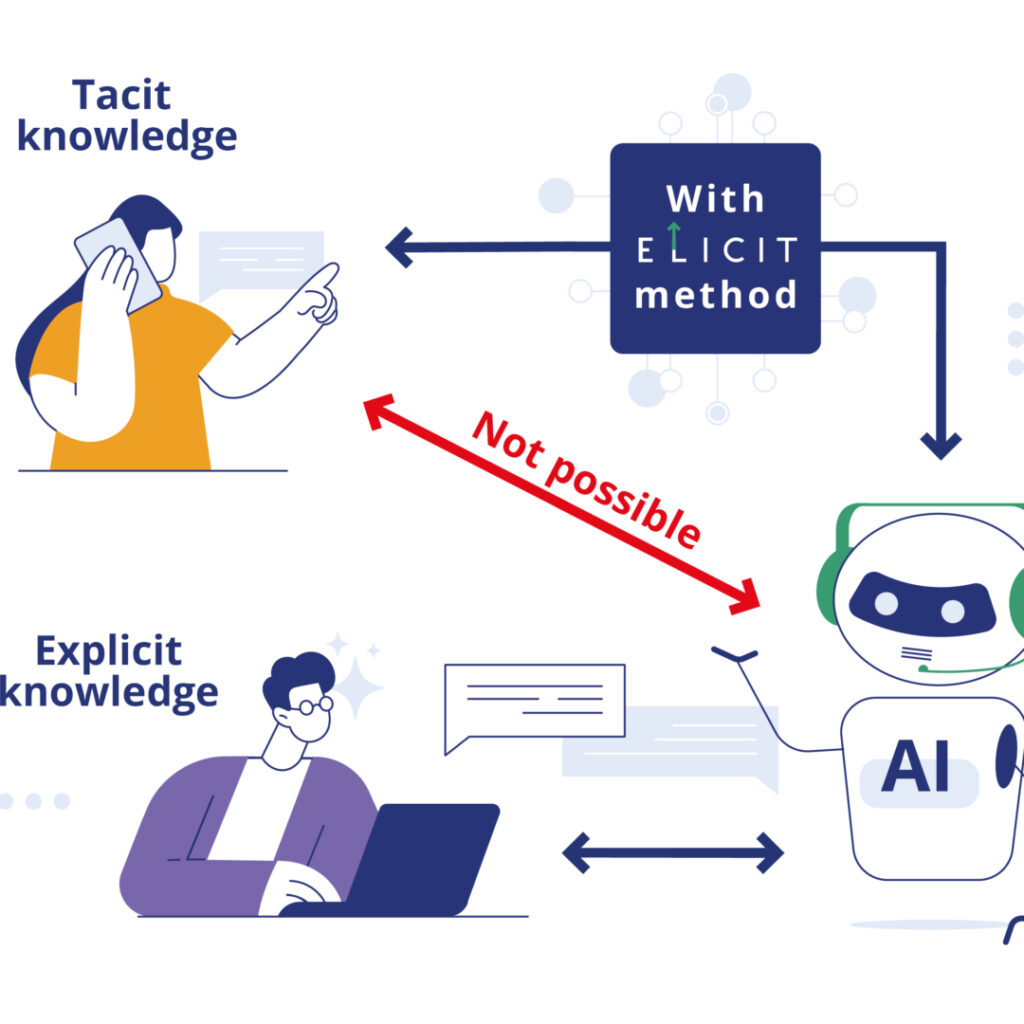
If you ask an expert to write down their knowledge themselves, you do not get their knowledge. You get their perception of their knowledge. These are often procedural steps, technical facts about the machines, and known cause-and-effect relationships. All very important to record, but not sufficient.
Experts largely work intuitively. They process dozens of signals simultaneously, weigh them based on years of experience, and arrive at a decision that they can hardly reconstruct afterwards. Cognitive scientists call this ‘tacit knowledge’: implicit knowledge stored as an automatic pattern, rather than conscious reasoning.
In practice, that intuition looks like this: when Jan stops a line, it stems from a combination of vibration levels, color nuances, ambient temperature, and a slight deviation in viscosity. All at once. Ask him why he intervened and he says: “Something just wasn’t right.”
Ask an expert why he intervened and he won’t tell you about the 15 parameters he unconsciously monitors. He says: “Something just wasn’t right”
What experts cannot transfer on their own
If you ask an expert to describe what he does, he will not describe those fifteen parameters he unconsciously monitors before intervening. And it is precisely those parameters, that intuition, that decision logic, that you really want to capture for his successors.
Research involving more than 200 experts shows that every expert works with a core set of 10 to 30 parameters that determine quality and process control. Not 200 parameters, but 10 to 30. Which ones they are, and in what order they matter, differs per situation and is deeply rooted in years of experience. A junior operator does not have that set.
Then there is the exceptional knowledge: the 5% of situations that fall outside the standard protocol but cause 80% of failure costs. The expert has experienced those exceptions, solved them, and learned the painful lessons. But if you ask him to write a manual, he won’t bring them up spontaneously. Because that never happens, right?
Jan’s value does not lie in what he writes down
Jan’s value does not lie in what he writes down when you ask him to create a manual. Jan’s value lies in what goes through his head when something isn’t right on a Friday afternoon at a quarter to two.
That requires a different approach than “just write it down.” It requires structured extraction by someone who knows which questions to ask to bring implicit decision logic to the surface.
“What was previously intuitive has now been given a logical structure.”
Viljo Pos, Production Manager at Burg Azijn

What does work
The key lies in how you ask the questions. All experts, whether they work in the food industry, metal processing, or chemistry, share the same underlying knowledge structure: a decision-making process with a parametric information flow.
If you know that structure, you can ask targeted questions that unlock implicit knowledge. Not ‘describe what you do,’ but ‘what is the first thing you see that tells you something is about to go wrong?’ Not ‘write a manual,’ but ‘if parameter X deviates and parameter Y is simultaneously increased, what is the first thing you do?’
Through five structured interviews, based on a protocol of 110 questions (developed from more than 12 years of research), it is possible to translate decades of implicit experience into a usable knowledge system. Not a manual that describes what everyone already knows, but an interactive model that helps you make decisions like an expert, step by step.
And that works, as they have seen at vinegar producer Burg Group: “What was previously intuitive has now been given a logical structure. Complex connections in the process are suddenly understandable. It provided insight into which aspects were obvious to experienced operators but unclear to others,” says Viljo Pos, production manager. “We gained insight into the underlying logic of their decisions.”
What this means for your expert and your organization
For Jan himself, it is a relief. He wants to transfer his knowledge, and with this approach, he discovers how rich and structured his knowledge actually is. That provides recognition.
For the operations manager, it means no longer being dependent on whether Jan is there. No more tension when Jan goes on vacation for two weeks. And, when Jan leaves next year, the certainty that his knowledge won’t walk out the door with him.
Discover how to properly secure expert knowledge
Are you curious about which knowledge has not yet been secured with your experts? Schedule an introductory meeting and discover in 30 minutes where the blind spots are in your organization.